
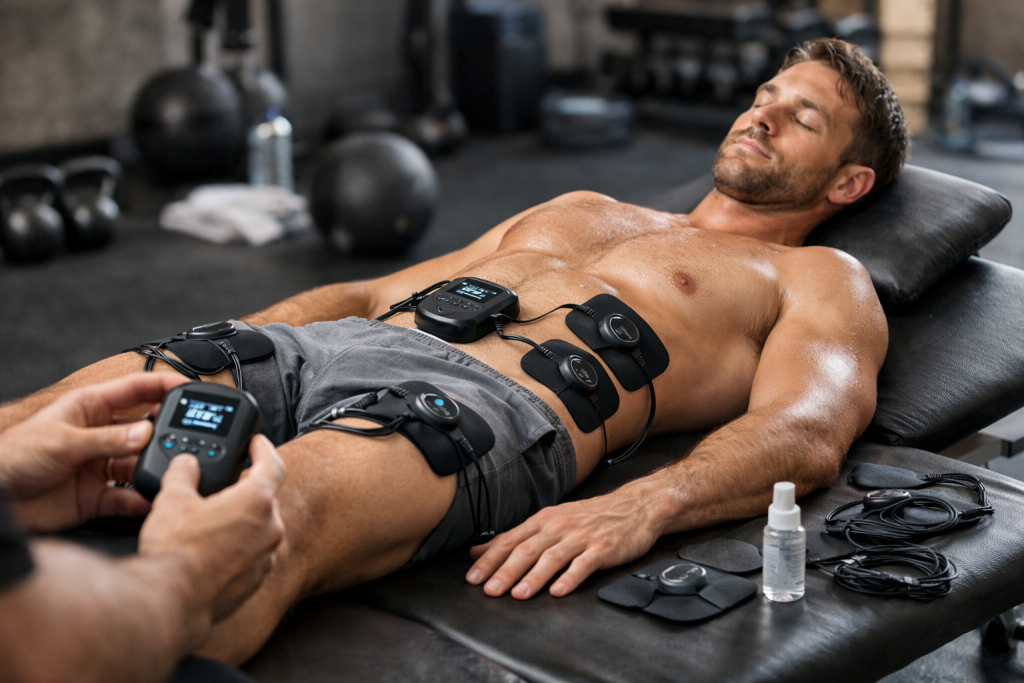
Perhaps you’ve come across an advertisement for a gadget that promises to tone muscles for users effortlessly. Or, you’ve heard of athletes who use electrical current or pulses to speed up muscle recovery after an intense workout session. These tools are known as EMS (Electrical Muscle Stimulators). But do they really boost muscle recovery and your well-being, or are they just hyped advanced gadgets with a cool name? In recent times, several studies have been conducted to test their effectiveness.
This guide breaks down what EMS devices are, the science behind their operation, and how they aid in muscle recovery.
EMS Devices
These gadgets transmit tiny and soft electrical currents through the skin and into the muscles. But for them to work, you must first apply a gel, then attach a pad to your skin. The pulses flow through your system and convey signals to the muscles, subsequently triggering contraction, toning, and relaxation.
After an intensive workout, your muscles may experience some discomfort and temporary weakness. It’s a normal process that is caused by micro-tears in the fibers that build the muscles. This makes them stiff and tender, and the pain that you feel is part of the recovery process.
Repair of the small tears in muscle tissue may take time, prolonging the recovery process. But the EMS muscle recovery devices can speed up this process by stimulating the muscles using gentle pulses. These currents boost blood circulation to the muscles, thereby improving the intake of minerals and oxygen. Then, your muscles will heal quickly, and you’ll recover from aches. It’s like an enhanced massage session meant to penetrate into the deep muscle fibers with little effort.
Individuals use this method for many reasons. Some want to build their muscles while others aim to speed up their recovery after a workout. But in the medical field, patients can benefit immensely from the EMS device, as it helps muscles recover after an injury or operation. It strengthens and builds them over time.
The Science Behind EMS Stimulators and Muscle Recovery
When you are working out, the brain automatically transmits signals to the muscles for them to contract. EMS muscle devices work the same way since they send stimulators to your nerves and cause the muscles to relax or contract without involving the brain function. So it’s just like working out without you lifting any weight or taking steps.
Scientific research has shown some positive results, with some studies more convincing than others. According to several studies on EMS in football players and other athletes, those who used the device recovered more quickly. Also, players recover from aches and soreness after using the device. Also, the healing of lower limbs is quicker, and their muscles become stronger.
The conclusion is that the gadget allows players to bounce back onto the pitch and continue with their training more quickly. Researchers generally agree that it’s effective in individuals who are recovering from an operation, especially those who are bedridden and can’t move their limbs. This tool prevents the muscle fibers from losing their overall strength. Despite these positives, studies are still being done to gather more evidence on its effectiveness. Some researchers argue that the device may work in certain situations, and it’s not a magic tool for everyone.
EMS Tools vs. Other Similar Gadgets
It’s possible to get overwhelmed by the number of muscle recovery gadgets available out there. The market is overflowing with similar devices that work like the EMS devices, and sometimes it can be difficult to tell the difference. Not all brands and makes can be trusted and using the wrong ones may cause more health issues.
Some of these target pain points by disrupting the signals that cause pain and stopping muscle aches. Others are stronger high-tech devices used in hospitals and clinics. Some advanced options have the combination of all brands into a single unit.
In Summary
Before buying this device, you need to know what you want to achieve by using it. If you engage in rigorous workouts, it may help you in recovery. If you are into strength training and looking to build bigger muscles, it’s a good choice. For those recovering from surgery, medics can use it to ensure the muscles do not waste away.
However, you should know that the device alone may not work in isolation. It’s important to adhere to key health practices such as eating healthy food and staying hydrated. Does an EMS device help in recovery? The genuine answer depends on why you need to use it.